
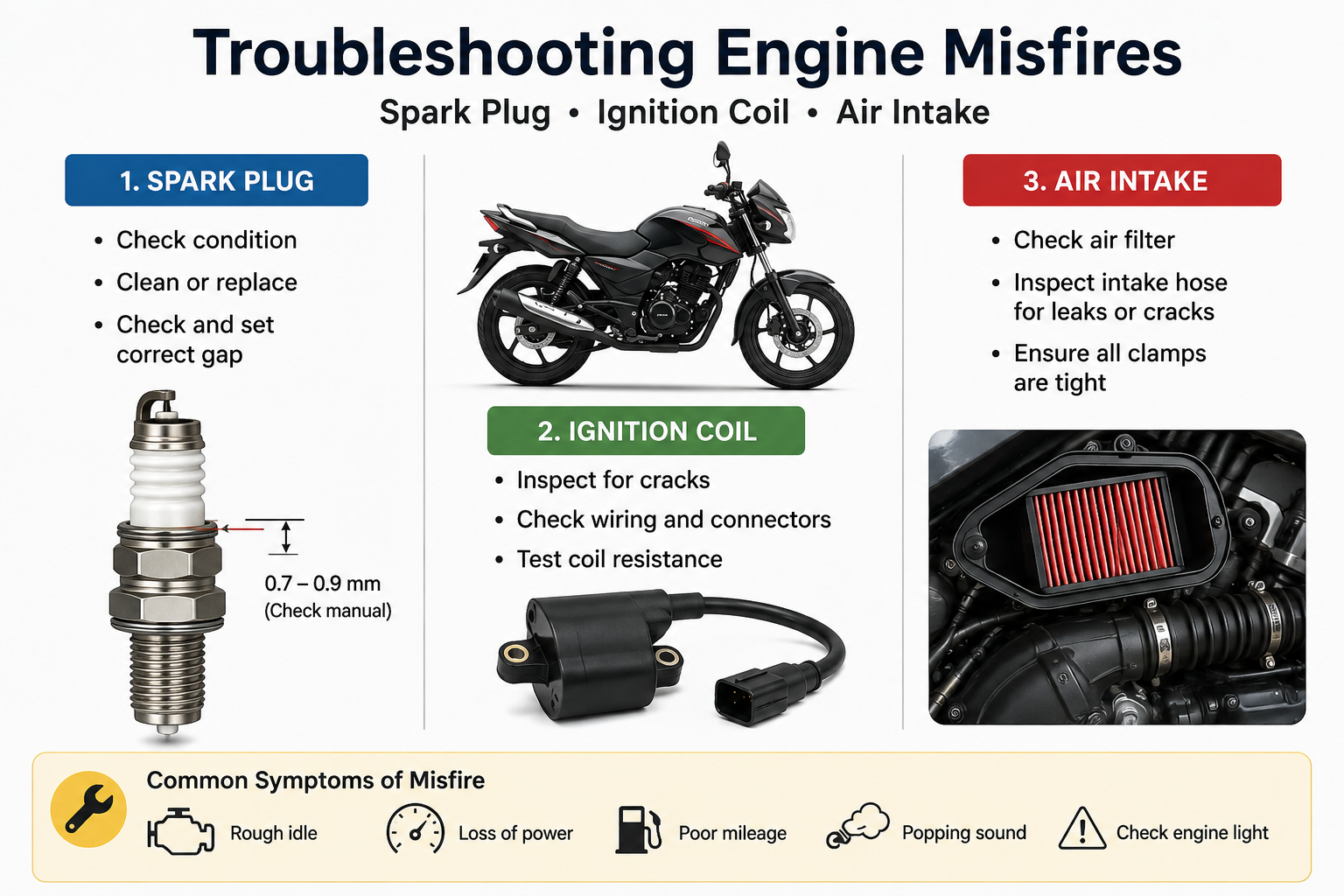
An engine misfire occurs when one or more cylinders fail to burn the air-fuel mixture properly. On a motorcycle, this can feel like hesitation, jerking, rough idling, reduced acceleration, or an unusual popping sound from the exhaust.
While a misfire can sometimes indicate a serious engine problem, many cases are caused by relatively straightforward issues involving the spark plug, ignition coil, or air intake system.
Here’s how to identify the most common causes and what to check first.
What Is an Engine Misfire?
During normal operation, the engine draws in air, mixes it with fuel, compresses the mixture, and ignites it with a spark.
A misfire happens when combustion is incomplete or doesn’t occur at all.
Typical symptoms include:
- Rough or unstable idling
- Hesitation during acceleration
- Sudden loss of power
- Jerking while riding
- Poor fuel economy
- Difficulty starting
- Popping from the exhaust
- Check-engine warning light on fuel-injected motorcycles
A persistent misfire shouldn’t be ignored because continued operation can increase engine stress and, on some motorcycles, potentially damage the catalytic converter.
1. Start With the Spark Plug
The spark plug is one of the easiest components to inspect and is often the first place to begin troubleshooting.
Remove the plug and check its condition.
What to Look For
Normal appearance: A relatively clean electrode with light deposits generally indicates normal operation.
Heavy carbon deposits: Can indicate incomplete combustion, an overly rich mixture, or prolonged low-speed operation.
Wet with fuel: May indicate that fuel is reaching the cylinder but isn’t being ignited properly.
Oil-fouled: Can point toward oil entering the combustion chamber and requires further investigation.
Damaged or worn electrode: The plug should be replaced.
2. Check the Spark Plug Gap
The gap between the spark plug’s center and ground electrode determines how easily the ignition system can produce a spark.
If the gap is too wide, the ignition system may struggle to jump the gap, particularly under engine load.
If it’s too narrow, the spark may be weaker or combustion characteristics may change.
More importantly, don’t use a generic gap specification. Check your motorcycle manufacturer’s service manual for the correct measurement.
Use a proper spark-plug gap gauge to measure it. If adjustment is permitted for your specific plug, make small adjustments carefully rather than forcing the electrode.
3. Inspect the Ignition Coil
If the spark plug looks healthy and the gap is correct, the ignition coil is another component worth checking.
The ignition coil converts the motorcycle’s relatively low electrical voltage into the much higher voltage required to produce a spark.
A failing coil can cause:
- Intermittent misfires
- Weak acceleration
- Hard starting
- Misfires that become worse as the engine warms up
- Loss of power at higher RPM
Basic Coil Checks
Start with a visual inspection.
Look for:
- Cracks in the coil housing
- Damaged wiring
- Loose electrical connectors
- Corrosion around terminals
- Damaged plug caps or ignition leads
Resistance measurements can also be useful, but specifications vary significantly between motorcycles. Compare readings against the manufacturer’s service-manual specifications rather than relying on a universal resistance value.
4. Examine the Air Intake System
An engine needs the correct amount of air to maintain proper combustion.
A leak in the intake system can allow unmetered air into the engine, potentially creating an excessively lean mixture.
Inspect:
- Air filter
- Airbox
- Intake boot
- Throttle-body connections
- Vacuum hoses
- Clamps and seals
Look for cracks, loose connections, or hoses that have become disconnected.
Why Intake Leaks Cause Misfires
If additional air enters after the airflow has been measured or controlled, the engine may receive more oxygen than expected relative to the amount of fuel being delivered.
This can produce:
- Rough idle
- Hesitation
- Surging
- Popping during deceleration
- Poor throttle response
5. Don’t Ignore the Air Filter
A severely dirty air filter can restrict airflow and affect engine performance.
Check whether the filter is:
- Excessively dirty
- Damaged
- Wet or contaminated
- Improperly installed
Replace or clean it according to the manufacturer’s instructions. Don’t wash a disposable paper filter unless the manufacturer specifically says it is washable.
6. Check for Fuel-Related Problems
Not every misfire is caused by the ignition system or air intake.
Fuel delivery problems can produce very similar symptoms.
Possible causes include:
- Dirty fuel injector
- Restricted fuel filter
- Weak fuel pump
- Contaminated fuel
- Incorrect fuel pressure
If the spark and air intake systems check out, fuel delivery should be investigated next.
7. Consider Sensors and Electronics
Modern fuel-injected motorcycles rely on sensors and an engine control unit to determine how much fuel to inject.
Problems with components such as the:
- Oxygen sensor
- Throttle-position sensor
- Intake-air-pressure sensor
- Engine-temperature sensor
can affect fueling and potentially contribute to poor combustion.
If your motorcycle has a check-engine light, retrieving diagnostic trouble codes can make troubleshooting much faster.
A Simple Troubleshooting Sequence
Rather than replacing expensive components immediately, work through the basics in order:
Engine misfire → Spark plug → Plug gap → Coil & connections → Air filter → Intake leaks → Fuel system → Sensors/diagnostics → Compression
This approach helps identify simple problems before moving on to more complicated or expensive repairs.
When Compression Testing Is Necessary
If ignition, air intake, and fuel systems appear normal but the misfire continues, the problem could be mechanical.
Potential causes include:
- Low compression
- Valve-clearance problems
- Damaged valves
- Worn piston rings
- Head-gasket issues
A compression test can help determine whether the cylinder is mechanically healthy. This is generally a point where professional diagnosis becomes worthwhile.
Common Troubleshooting Mistakes
Replacing Parts Without Testing
Don’t automatically replace the ignition coil, injector, or ECU because of a misfire. Test or inspect components first.
Using the Wrong Spark Plug
The correct heat range, design, and specification matter. Always use the plug recommended for your motorcycle.
Guessing the Spark Plug Gap
Different engines require different gaps. Always follow the manufacturer’s specification.
Ignoring Intake Leaks
A small cracked hose or loose intake connection can create significant drivability problems.
Continuing to Ride With a Severe Misfire
A persistent or severe misfire can cause additional damage. If the motorcycle is running very poorly, producing unusual noises, or showing a flashing engine warning light, stop riding and have it inspected.
Frequently Asked Questions
Can a wrong spark plug gap cause a misfire?
Yes. An incorrect gap can interfere with reliable spark generation and cause misfires, particularly under load.
How do I know if my ignition coil is bad?
Symptoms can include intermittent misfires, difficult starting, poor acceleration, and performance that deteriorates as the engine gets hot. Proper testing against the manufacturer’s specifications is the best way to confirm a faulty coil.
Can an air leak cause an engine misfire?
Yes. An intake leak can introduce unmetered air and create an excessively lean mixture, potentially causing rough running and hesitation.
Should I replace the spark plug when troubleshooting a misfire?
If the plug is worn, damaged, badly fouled, or has an incorrect gap that cannot be corrected according to the manufacturer’s instructions, replacement is appropriate.
Final Thoughts
Troubleshooting a motorcycle engine misfire doesn’t necessarily mean replacing expensive parts. Start with the basics: inspect the spark plug, verify its gap, examine the ignition coil and wiring, and check the entire air-intake system for restrictions or leaks.
If those components are healthy, move on to fuel delivery, electronic diagnostics, and eventually compression and other mechanical checks.
The key is to diagnose the cause rather than simply replacing parts. Following a systematic troubleshooting process can save money, prevent unnecessary repairs, and get your motorcycle back to smooth, reliable performance.