Your motorcycle’s braking system plays a critical role in your safety, whether you’re commuting through busy city traffic, cruising on highways, or riding through winding mountain roads. While brake discs and calipers often receive attention, the type of brake pads you use can also make a significant difference in braking performance, durability, noise, and maintenance costs.
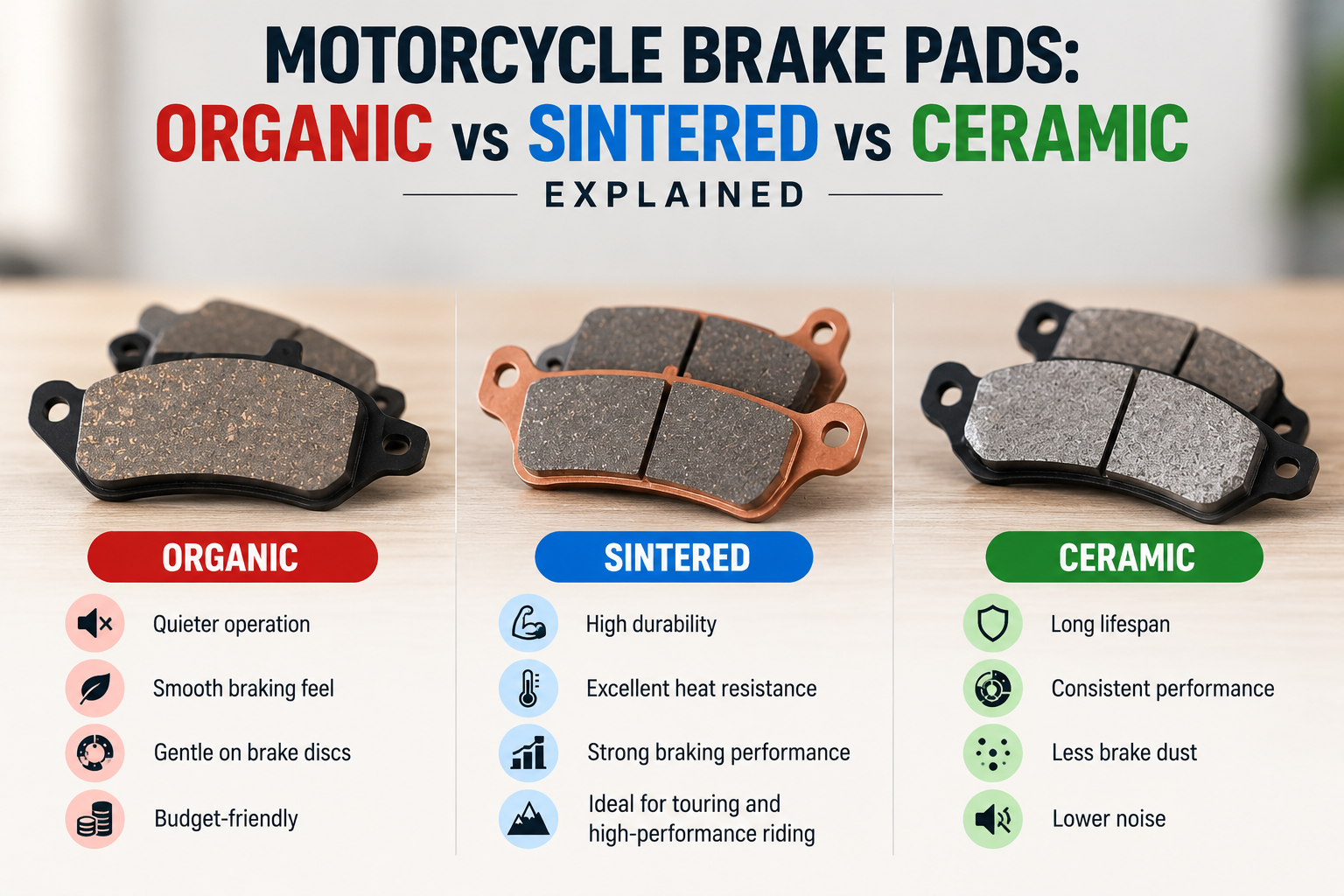
Motorcycle brake pads are generally available in different friction-material formulations, including organic, sintered, and ceramic-based options. Each type has its own advantages and limitations, making it important to choose pads that suit your motorcycle and riding conditions.
In this guide, we’ll explain the differences between organic, sintered, and ceramic motorcycle brake pads and help you understand which option may be right for your bike.
What Are Motorcycle Brake Pads?
Brake pads are friction components fitted inside a motorcycle’s brake caliper. When you apply the brake lever or pedal, the pads press against the rotating brake disc, generating friction that slows the wheel.
The friction material determines how the pads behave under different conditions, including high temperatures, repeated braking, wet weather, and everyday commuting.
Choosing the right brake pads can help you achieve predictable braking, suitable durability, and consistent performance.
1. Organic Motorcycle Brake Pads
Organic brake pads are made primarily from non-metallic friction materials, such as fibres, resins, and other compounds. Some formulations also contain small quantities of metallic materials.
They are often designed to provide smooth, relatively quiet braking for everyday riding.
Advantages of Organic Brake Pads
- Quiet operation: Often produce less braking noise than some sintered alternatives.
- Smooth braking feel: Can offer progressive braking suitable for city traffic.
- Gentle disc interaction: Many formulations are relatively gentle on brake discs.
- Budget-friendly options: Often available at an accessible purchase price.
Disadvantages of Organic Brake Pads
- May wear faster under demanding conditions.
- Can experience reduced performance at very high temperatures.
- May be less suitable for repeated heavy braking.
- Performance varies considerably between formulations.
Best For
Organic pads can be a good option for commuters who primarily ride in urban areas, prefer quiet braking, and want an economical replacement.
However, always verify that the specific pad is approved for your motorcycle and brake system.
2. Sintered Motorcycle Brake Pads
Sintered brake pads are manufactured by bonding metal particles together under high temperature and pressure. Their friction compounds are designed to withstand demanding braking conditions.
Many performance motorcycles use sintered pads as original equipment, particularly where high-temperature braking performance is important.
Advantages of Sintered Brake Pads
- Strong braking performance: Many formulations provide high friction and predictable stopping power.
- Heat resistance: Generally well suited to repeated braking under demanding conditions.
- Durability: Often last longer than organic pads in demanding applications.
- Versatility: Suitable formulations are available for commuting, touring, and performance riding.
Disadvantages of Sintered Brake Pads
- May produce more noise.
- Can generate more brake dust, depending on the formulation.
- Some compounds may accelerate brake-disc wear.
- May cost more than basic organic alternatives.
Best For
Sintered pads are worth considering for riders who regularly travel on highways, ride in mountainous terrain, carry heavy loads, or demand consistent braking under repeated high-temperature conditions.
The exact performance depends on the pad compound, disc material, and braking system.
3. Ceramic Motorcycle Brake Pads
The term ceramic brake pads can be confusing in the motorcycle market. Unlike the familiar ceramic formulations used in many passenger-car brake pads, motorcycle products marketed as ceramic may use different combinations of ceramic fibres, metallic ingredients, and other friction materials.
For this reason, the product’s actual specifications matter more than the label alone.
Potential Advantages
- Some formulations offer relatively quiet braking.
- Certain compounds produce less visible brake dust.
- Some provide smooth, consistent braking under everyday conditions.
- Suitable products may offer good durability.
Potential Disadvantages
- Performance differs significantly between products.
- Some may offer less initial bite than a suitable sintered compound.
- Premium formulations can be more expensive.
- Not every ceramic-labelled pad is designed for high-performance motorcycle braking.
Best For
A ceramic-based motorcycle brake pad may be appropriate for everyday or mixed riding when its manufacturer confirms compatibility with the motorcycle and the intended use.
Don’t assume that every ceramic pad is quieter, lasts longer, or stops better than every organic or sintered pad.
Organic vs Sintered vs Ceramic: Key Differences
| Feature | Organic | Sintered | Ceramic-based |
|---|---|---|---|
| Friction material | Fibres and resins, sometimes with metals | Bonded metal particles and additives | Ceramic fibres or compounds, formulation-dependent |
| Braking feel | Often smooth and progressive | Often strong and responsive | Varies by compound |
| High-temperature use | Depends on formulation; some have limitations | Generally well suited to demanding heat conditions | Depends on product specification |
| Noise | Often relatively quiet | Can be noisier | Some formulations are quiet |
| Brake dust | Varies | Varies; can be relatively high | Some formulations produce less visible dust |
| Wear life | Often shorter under heavy use | Often durable under demanding use | Varies by formulation |
| Typical application | Everyday commuting | Touring and demanding braking | Everyday or mixed riding, where approved |
These are general tendencies, not guarantees. Two products within the same category can perform differently.
Which Brake Pads Are Best for Your Riding Style?
For Daily Commuting
If you ride mostly in city traffic, look for predictable braking, good cold performance, manageable noise, and reasonable cost.
An approved organic pad may suit your needs, although many motorcycles are designed to use sintered pads from the factory.
For Highway Riding
Highway riding involves higher speeds and can require substantial braking force when traffic conditions change.
Choose a pad that provides consistent performance at the temperatures expected in your riding conditions. A suitable sintered compound may be a strong choice.
For Mountain Roads and Touring
Repeated braking on long descents can generate considerable heat.
A compatible sintered pad designed for touring or demanding use is often worth considering. Correct braking technique, brake condition, and regular inspections remain essential.
For Sport and Performance Riding
Performance riders need predictable braking and resistance to friction changes as temperatures rise.
Choose a compound specifically designed for your motorcycle’s braking system and intended use. Track riding may require a different pad specification from normal road riding.
How to Choose the Right Brake Pads for Your Motorcycle
Before purchasing replacement pads, consider the following factors.
1. Check Compatibility
Confirm the exact motorcycle model, model year, brake caliper, and pad part number. Front and rear brake pads may have different specifications.
2. Follow the Manufacturer’s Recommendations
Use the friction-material type and specifications approved for your motorcycle. Don’t change pad types solely because another compound is advertised as more powerful.
3. Consider Your Riding Conditions
Frequent city braking, heavy touring, wet conditions, and spirited riding place different demands on brake pads.
Select a compound suited to your actual use rather than choosing based only on price or marketing claims.
4. Check Brake Disc Compatibility
Not every pad compound is suitable for every disc. Confirm compatibility with the disc material and braking system.
5. Buy From a Reliable Supplier
Choose genuine or reputable replacement parts with traceable specifications. Poor-quality friction materials can compromise braking performance and durability.
6. Bed In New Brake Pads Correctly
New pads generally require a bedding-in procedure to establish an appropriate contact surface between the pads and disc.
Follow the pad manufacturer’s instructions, avoid unnecessarily aggressive braking during the process, and check that braking feels normal before returning to demanding riding.
Signs Your Motorcycle Brake Pads Need Replacement
Inspect your brake pads regularly and look for:
- Friction material approaching the specified wear limit.
- Reduced braking performance.
- Persistent grinding or unusual noises.
- Uneven pad wear.
- Brake-related vibration or pulsation.
- A brake-wear indicator or warning, where fitted.
Squealing alone does not always mean the pads are worn, but grinding, sudden braking changes, or metal-to-metal contact require immediate attention.
If braking performance deteriorates noticeably, stop riding when it is safe to do so and have the system inspected.
Common Mistakes to Avoid
Choosing pads based only on price: Cheap pads are not automatically poor, and expensive pads are not automatically better. Verify quality, compatibility, and specifications.
Assuming harder pads always stop better: Braking depends on the complete system, including friction material, disc condition, tyre grip, temperature, and rider input.
Mixing incompatible components: Use approved combinations of pads and discs.
Ignoring bedding-in instructions: Incorrect bedding can affect initial braking performance and contact between the pad and disc.
Neglecting the rest of the braking system: Brake fluid, calipers, hoses, discs, and tyres also require proper maintenance.
Frequently Asked Questions
Are sintered brake pads better than organic pads?
Sintered pads generally perform well under high-temperature and demanding braking conditions. Organic pads can provide quiet, progressive braking for everyday use. The better choice depends on your motorcycle’s requirements and riding style.
Do ceramic brake pads last longer?
Some ceramic-based formulations offer good durability, but lifespan depends on the compound, riding conditions, braking habits, and disc compatibility. The ceramic label alone does not guarantee longer life.
Which brake pads are best for Indian roads?
There is no single best type for every Indian road condition. Daily commuters may prefer a suitable organic or sintered pad, while riders undertaking mountain touring or demanding highway use may benefit from an approved sintered compound. Always check the motorcycle manufacturer’s recommendation.
Can I switch from organic to sintered brake pads?
Only if the sintered pad is approved for your motorcycle and compatible with its brake discs and calipers. Follow the manufacturer’s specifications and installation instructions.
Should front and rear brake pads be the same type?
Not necessarily. Some motorcycles use different specifications or compounds at the front and rear. Follow the approved parts information for each brake.
Final Thoughts
Organic, sintered, and ceramic-based motorcycle brake pads each offer different characteristics. Organic pads often suit quiet, everyday riding; sintered pads are frequently preferred for demanding braking and high-temperature use; and ceramic-based products can offer useful everyday characteristics when their specifications match the application.
The most important factor is not the material label alone. Choose brake pads that are compatible with your motorcycle, approved for your braking system, and suitable for your riding conditions. Inspect your brakes regularly, install quality components, and follow the correct bedding-in procedure to maintain safe, dependable braking.